


*Exclusions apply. By subscribing, I confirm that I am 18 years of age or older and agree that my personal information may be used by SafetyEyeglasses.com to send me news, special offers, and other marketing communications. For more details, please review our Terms & Conditions and Privacy Policy. You may unsubscribe at any time.
- Safety Glasses
Collection
Feature
Shop By
- Vouchers
Blog
What Are the Parts of Glasses Called?
Eyewear is an interesting combination of both medical needs and personal fashion. We spend most of the day in glasses. We depend on them to see the world clearly. In the same way, we trust them to protect our eyes in the workplace. However, few people are aware of the names of the parts. Do you know what the "temple" is? What is the difference between a bridge and a pad arm?
It is so much more useful to know the anatomy of your glasses. It helps you when you need a repair. And it helps you when you are shopping online for a new pair. It also ensures you are using the right safety equipment for your job. This guide is a thorough analysis of every screw, hinge, and lens coating. Let’s explore the intricate world of eyewear.
Understanding the Glasses Anatomy
One of the most successful inventions in the history of humanity is eyewear. In its simplest form, a pair of glasses is a fine optical tool. We even use them as mere accessories to fashion. However, they are complex mechanical assemblies designed to be installed on a moving human face. You can identify why a pair feels heavy or why the lenses are fogging. Every millimetre of the frame is engineered to balance weight and clarify vision.
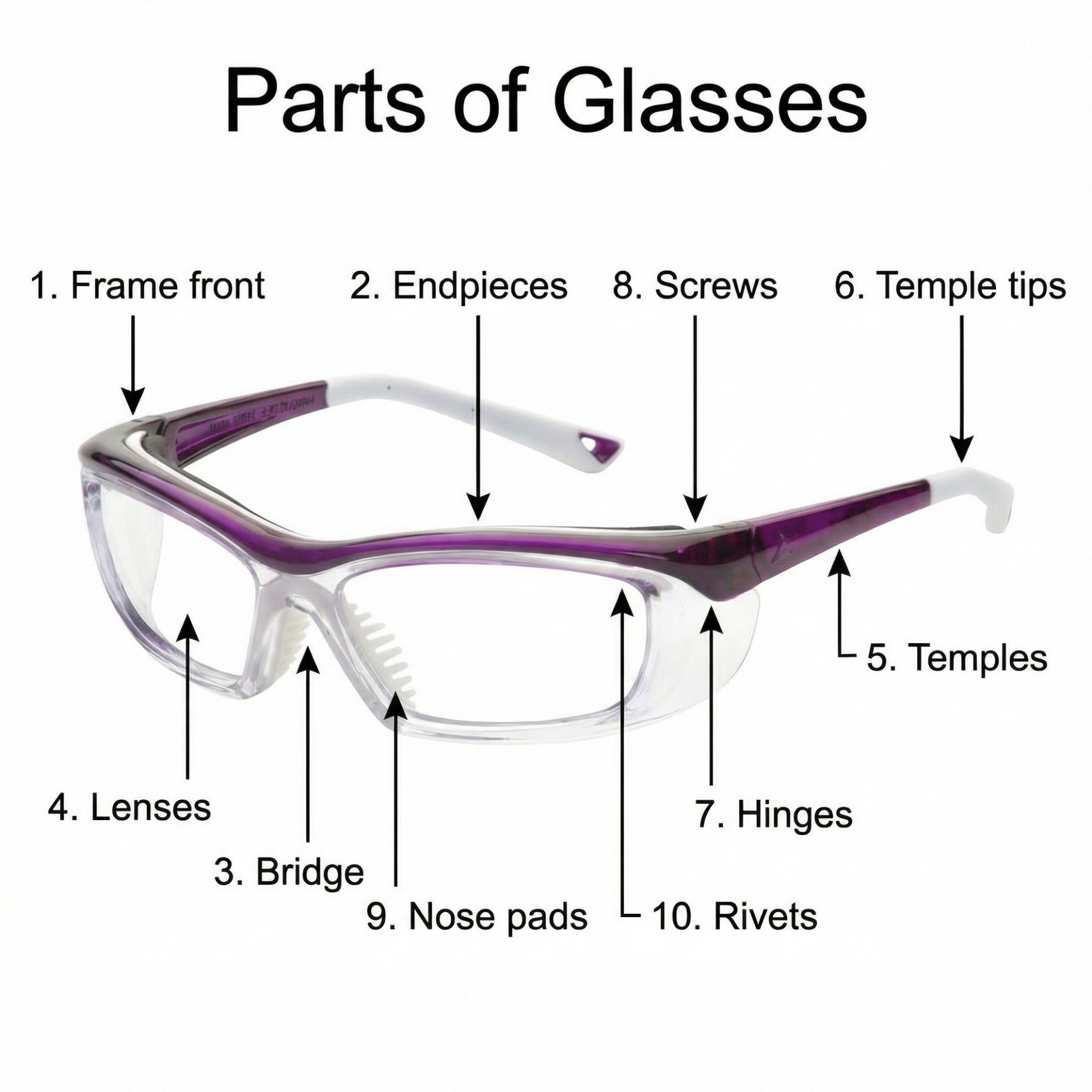
Most eyewear consists of two primary assemblies: the front and the temples. The front is the "frame" that holds your prescription. The temples are the "arms" that provide stability. Between these two are smaller, vital components. These consist of hinges, screws, and nose pads. These elements interlock in a standard parts of glasses diagram to form a rigid and flexible structure. One screw can go dead, and the entire system will be useless.
Significant Distinctions Between Fashion, Reading, and Safety
Not all glasses are created equally. Their design depends entirely on their intended environment.
- Fashion Glasses: These prioritize aesthetics. They often use thin metals or decorative acetate. The parts of the glasses frame in fashion are usually slim and lightweight.
- Reading Glasses: These are built for "task-specific" use. Parts of reading glasses often feature spring hinges. These allow for frequent "on-and-off" wear without stretching the frame.
- Safety Glasses: They are the heavy-duty types. They are designed to resist high-velocity impacts. Safety versions, unlike regular frames, come with side protection and strong eye wires.
Frame Architecture
The parts of the glasses frame are the most varied. It's "bridge" rests on your nose. The "rims" or "eye wires" encircle the lenses. The "end-pieces" are the corners where the frame meets the temples. In premium frames, these parts are often reinforced with wire cores. This allows for manual adjustment.
A visual parts of glasses diagram acts as a roadmap for maintenance. It shows you where the "nose pad arms" attach and how the "hinge barrels" align. By mastering this foundational anatomy, you move beyond being a wearer. You become an informed user who can maintain their vision and protect their investment.
Lenses The Heart of Vision
The lens is the most vital component of any eyewear system. While the lens provides the function, the frame provides the style and support. A lens is just a transparent material that refracts light. For the images you see to precisely land on your retina, the lens bends the light rays that pass through. The world is a gray tangle of light and shadow without this computation.
Lens Types
Lenses are not "one size fits all." They are customized to the refractive errors of the wearer.
- Single Vision: Single vision are the most common lenses. They possess one focal power across the entire surface. They correct for either distance, intermediate, or near vision.
- Bifocals lenses: Bifocals feature two distinct powers. Usually, the top is for distance, and a visible lower segment is for reading.
- Trifocal lenses: Trifocal lenses are eyeglass lenses featuring three distinct sections to correct vision for near, intermediate, and far focal points.
- Progressive Lenses: Progressive lenses are commonly known as no-line bifocals and provide a smooth changeover. They offer a range of powers that enable clear vision at all distances: long distance, mid-range, and close-up.
In the parts of the glasses diagram, the lens occupies the central space within the "eye wire" or rim. The placement is highly technical. Your pupil should be centered in the optical center of the lens. When the lens is not placed right in the frame, it may create prism effects, and this causes eye strain, nausea, and distorted vision.
Safety Lenses vs. Everyday Lenses
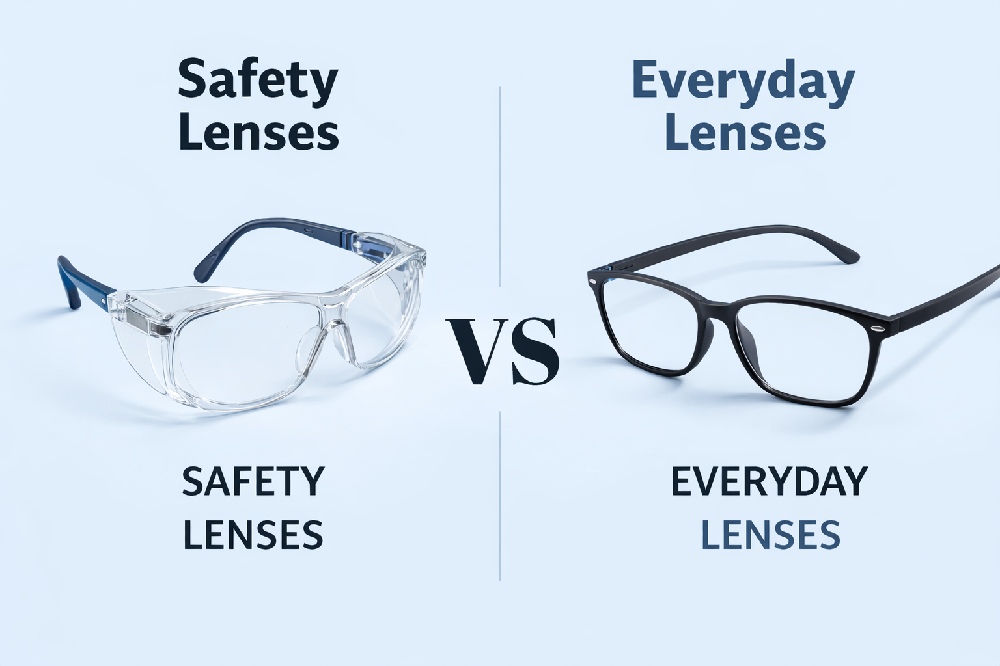
There is a massive structural difference between daily lenses and those used for protection. Ordinary lenses can be composed of CR-39 plastic or high-index resins. They are fragile and extremely clear, yet they can break under pressure. Safety lenses are a new breed. The majority of them are composed of polycarbonate or Trivex. These are very strong materials; they bend in when hit, not break into sharp fragments.
Materials and Maintenance
Modern safety equipment uses plastics, but there are also glass-lensed safety glasses. They are used in environments with high chemical exposure where plastic might melt or pit. However, glass is heavy and can break. That is why safety glasses replacement lenses are very popular within the industrial sector. Safety lenses are resilient to sparks, dust, and debris. They frequently require replacement to be compliant with OSHA.
Last Line of Defense Coatings
The coating makes the lens as good as it can be. Several layers are used to make it durable:
- Scratch-Resistant Coating: Coat resistant to surface abrasion on the soft polycarbonate.
- Anti-Reflective (AR): Removes distracting glint and ghost images.
- Anti-Fog: This is essential to safety, since it does not allow water to accumulate when people are doing the physical work.
Knowledge of these pieces will ensure that your glasses will be strong enough to provide you with clear, safe vision for many years ahead.
Holding It All Together: Frames and Structure
If the lenses form the core of the eyewear, the frame is the skeletal system. It gives you the necessary framework to ensure your vision is focused and your comfort is maintained. An effective frame is not just a good-looking frame. It regulates how your weight is distributed on your face and helps safeguard the fragile edges of your lenses.
Material Science Of Frames
The first step to the durability of your glasses is the material. The majority of common frames are either of metal or acetate. Acetate is a plant-based, environmentally friendly plastic that is in high demand because of its vivid colors and hypoallergenic qualities. Metal frames are often made of titanium, stainless steel, or Monel. However, the material needs vary when we consider safety glasses frames. They are usually composed of high-impact nylon. These are shape-memory polymers. They can bend in extreme conditions without breaking, which is essential in dangerous settings.
Parts of a Glasses Frame
A frame is an assembly of several specialized components, and its rims (or eye wires) surround the lenses. The bridge is the centrepiece that arches over the nose. The end-pieces are the outer corners where the front of the frame meets the temples. For those requiring vision correction in dangerous jobs, safety glasses prescription frames include a specialized "lens groove." This groove is deeper than a standard frame’s, ensuring that if a lens is struck. It stays locked in the frame rather than being pushed back into the wearer's eye.
Styles and Structural Integrity
The way a frame holds a lens changes its durability profile.
- Full-Frame: The material completely encircles the lens. This is the sturdiest option and is the standard for most safety gear.
- Semi-Rimless: The frame covers the top, while a thin nylon "supra" string holds the bottom. This is less weight and provides a broader view.
- Rimless: The temples and bridge are directly mounted through holes drilled in the lenses. Although stylish, they are the most delicate and are not used often in high-impact safety work.
Finding the Right Fit to Sizing and Comfort
Long-term wearability depends on proper frame sizing. A frame that is too slim will pinch the temples. With too wide a frame, it will continually slide down the nose. Common frame sizes have a three-number system (e.g. 52-18-140) that means lens width, bridge width and temple length. In safety, fit is a safety requirement. A frame with gaps on the sides lets in debris. Select a frame that suits your facial structure. It makes sure that the "construction" of your glasses is on your side and not against you.
Temples, Tips, and Hinges For Maximizing Comfort
The temples of your glasses are the primary anchors of your eyewear system. While the bridge manages the weight on your nose, the temples provide the lateral tension. The frames must be prevented from slipping forward. Comfort is a technical necessity in the realm of eyewear, not merely a luxury. The spectacles will result in migraines, pressure sores, or persistent slippage if the temples are improperly made.
Mechanics of the Temple
The temples (arms), explained simply, are the long pieces that extend from the frame front to behind your ears. However, their construction is quite detailed. When looking at the temple parts of glasses, we identify the "butt end" (the portion nearest the hinge), the "shaft" (the long middle section), and the "bend" (the curve that contours to the ear). Many plastic temples feature a "wire core" hidden inside. This metal rod allows an optician to heat and bend the material to match the unique shape of your skull. It ensures a custom fit that stays secure during movement.
Understanding the Folding Parts Hinges
A common question among new glasses wearers is: What are the folding parts of glasses called? These are the hinges. The hinge is the mechanical joint that allows the temples to fold inward for storage. There are two primary varieties used in modern eyewear:
- Standard Barrel Hinges: These consist of interlocking metal loops (barrels) held together by a tiny screw. They are sturdy and easy to repair.
- Spring Hinges: These include a small internal spring mechanism that allows the temples to flex outward beyond 90 degrees. This is particularly useful for those who take their glasses on and off frequently. As it prevents the frames from stretching out over time.
Navigating the Diagram
If you were to view a diagram temple parts of glasses, you would see the hinge. How the hinge is recessed into the "end-piece" of the frame. This alignment is critical. If even a fraction of a millimetre off the hinge, the glasses will sit crooked on the face. In safety eyewear, these hinges are often reinforced or "screwless". They ensure that no small parts can vibrate loose and fall into machinery or sensitive work areas.
Temple Tips Comfort
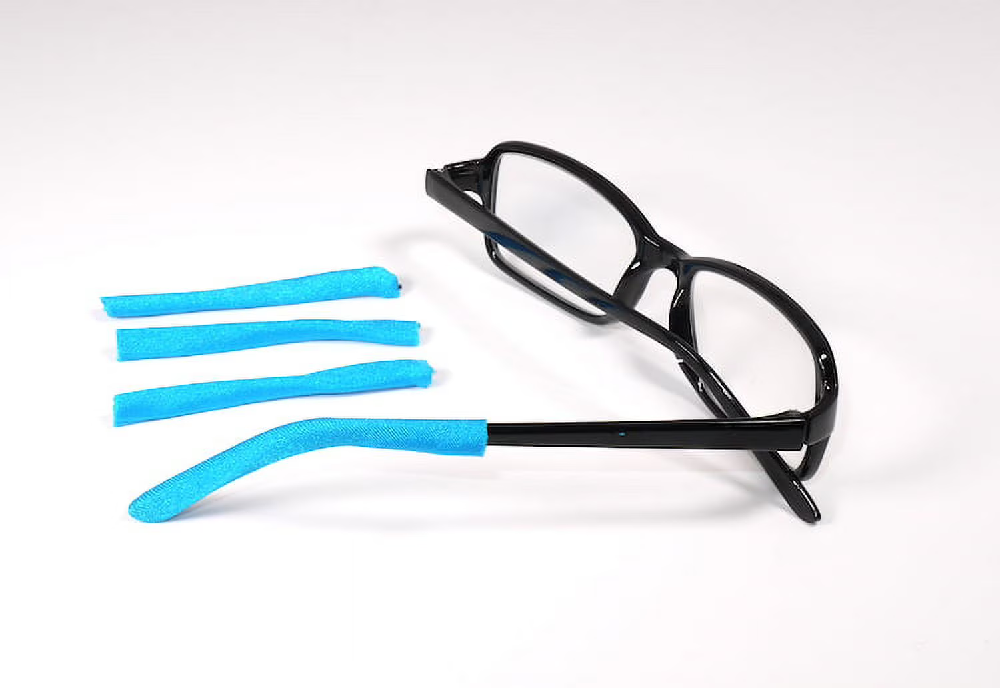
The final touchpoint of the eyewear is the temple tips. These are the covers at the very end of the arms that rest against the skin behind your ears. For maximum ear comfort, these tips are often made of soft silicone or acetate. In high-performance or safety models, manufacturers use "hydrophilic" rubber. This material actually becomes grippier as you sweat. It ensures that your glasses remain "in motion" with you, rather than falling off during physical labor.
Precision Placement of Bridge, Nose Pads, and Structural Support
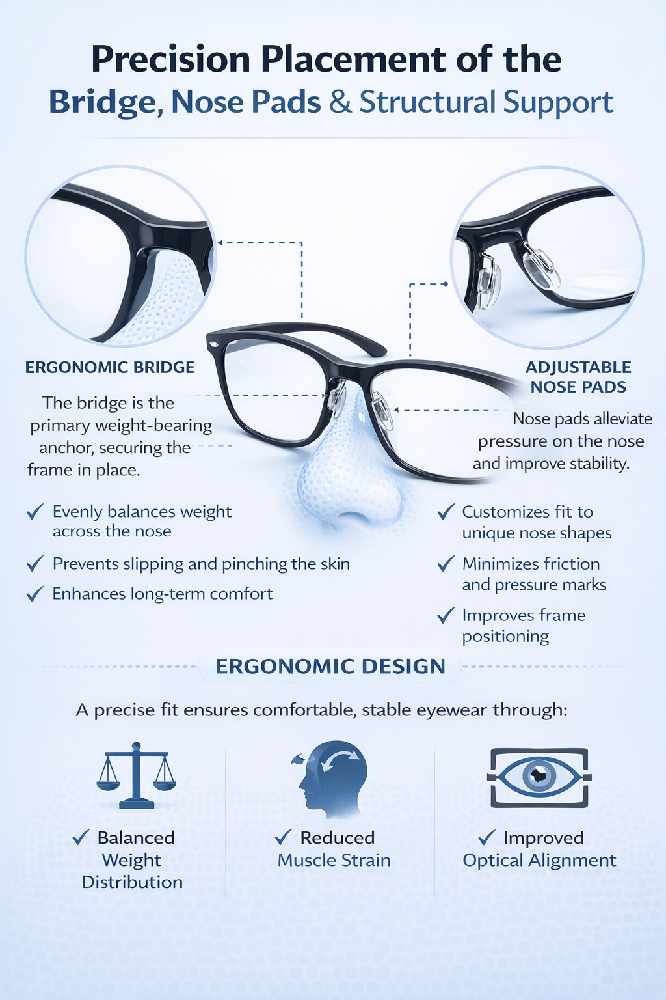
The bridge is arguably the most critical component for long-term comfort. It acts as the primary weight-bearing anchor for the entire frame. When installed improperly, the glasses will pinch the skin or continuously slip down the bridge. An ergonomic fit depends on the interactions of the frame with the distinct features of the human nose.
Types and Sizing of the Bridge
There are several bridge types designed to accommodate different nasal profiles. A saddle bridge distributes the weight over a greater surface area and is perfect for heavier frames. One of the shapes is that of a lock that was used a long time ago. It rubs the sides of the nose instead of the top, a great fit with a high bridge. The bridge size typically occupies the middle of the frame size (e.g., the 18 in 52-18-140). A bridge that is too wide causes the frames to sit too low, while one that is too narrow will "perch" the glasses too high on the face.
Support Systems: Nose Pads vs. Molded Bridges
Whether to use nose pads or molded bridges is frequently determined by the frame material. Nose pads are nearly always used on metal frames, small, pliable cushions of silicone or PVC. These are attached to "pad arms," allowing for three-dimensional adjustability. Conversely, acetate or plastic frames typically feature molded bridges. These are built directly into the frame front. While molded bridges offer a cleaner look and have no small parts to lose. They offer less adjustability than pad-arm systems.
Safety Glasses with Nose Pads For Stability in the Workplace
In high-risk environments, stability is a safety requirement. Safety glasses with nose pads are often engineered with "soft-grip" materials. These pads are frequently ribbed or textured to promote airflow and prevent "hydroplaning". The tendency for glasses to slide when the wearer sweats. This guarantees that even with intense physical effort, the protective seal will not break.
Adjustability and Pressure Points for Mastering the Fit
Managing the pressure points is the key to a disappearing fit. In case of redness or headache, then probably the pads do not fit the slope of your nose. Professional adjustability enables the user to make refinements on the distance between the eyes and the lenses. This is especially significant for various face shapes. For example, people whose face shape is heart-shaped usually enjoy lower-set bridges. Square-faced people might need wider-set pads to feel stable.
Specialized Anatomy of Safety Eyewear For Protection
Safety eyewear is not merely a sturdier version of fashion glasses. It is a complex piece of personal protective equipment (PPE). While standard glasses are designed for "static" environments like offices. Safety glasses are designed to handle dynamic hazards. They are the primary protection against high-velocity blows, chemical splashes, and air particulates. Every component must meet rigorous standards. Such as ANSI Z87.1, to ensure that the frame and lenses can survive a catastrophic hit without failing.
The most significant difference between standard and safety eyewear is the addition of side shields. Objects getting into the eye on the side cause most eye injuries. Side shields offer physical protection against flying sparks, chips of wood, or metallic fragments.
- Impact Protection: These shields consist of high-density polycarbonate. They are tested to make sure they do not break on contact.
- Maintaining Your Shields: Many workers commonly use detachable shields. It is important to know how to attach side shields to safety glasses; typically, you slide the shield over the temple and push the locking tab into the lock. On the other hand, when cleaning your frames, you must know how to extract the side shields of safety glasses. This usually requires pressing a small lever on the plastic and slipping the shield at the front of the frame.
- Sourcing Parts: When a shield cracks, it has to be changed. To get information on how to purchase safety side shields for glasses, you can visit our site. To ensure the safety rating, it is also important to purchase shields which are specifically listed in your frame model. Safety glasses are designed to handle dynamic hazards. They are the primary protection against high-velocity blows, chemical splashes, and air particulates.
Advanced Sealing Brow Guards and Gaskets
To provide 360-degree protection, safety glasses often feature a brow guard. This is a padded or plastic "shelf" along the top of the frame. It prevents sweat and falling debris from entering the eyes from above. For even harsher environments, a gasket (foam seal) is used. This foam ring creates a "closed-cell" seal against the face. It effectively turns a pair of glasses into a hybrid goggle. They block out fine dust and chemical vapors that would otherwise drift behind a standard lens.
Retention and Security: Straps and Retainers
In high-intensity jobs, the biggest risk is the glasses falling off. Lens retainers (or "croakies") are cords that hang around the neck. It ensures that if your glasses are knocked off, they don't fall into moving machinery. For maximum security, many safety frames allow you to swap the temples for a strap or headband. This converts the eyewear into a secure unit that wind or physical impact can not move. This is the gold standard for tactical and industrial professionals.
Why Safety Construction is Different
Standard frames are built to be thin. Safety frames are built with "lens retention" lips. This implies that the frame is thicker on the back of the lens. You can select the appropriate protection by learning these particular components of the safety glasses to use in your workplace.
Safety Part | What it Does | Best Environment |
Gasket | Seals out dust | Woodworking shops |
Brow Guard | Blocks overhead debris | Construction sites |
Side Shield | Lateral protection | Labs and factories |
Strap | Keeps glasses secure | High-movement jobs |
How to Select the Right Protection at Safetyeyeglasses?
A choice of the right safety glasses is not just a buy, but an investment in your health. When visiting a SafetyEyeGlasses, numerous choices can be confusing. Considering a handful of technical qualities, you can go beyond confusion and make a sure decision. It achieves a mix between ordinary comfort and cutting-edge security.
Selecting Hazard and Ratings
The best place to start is by determining your work hazards. Do you work with high-velocity flying shards, or do you worry more about fine dust and chemical splashes? To protect against impact, seek ANSI Z87.1 (United States) or CSA Z94.3 marks. Such standards guarantee that all components have been subjected to stringent industrial criteria. The sign of + before the Z87 mark means the high-impact rating that is necessary in grinding, machining, and construction.
Prescription Advantage
Numerous professionals find the use of over-the-glasses (OTG) goggles to be bulky and highly prone to fogging. You can order safety glasses prescription frames. By integrating your vision correction directly into impact-resistant polycarbonate lenses, you eliminate the "double-frame" weight and significantly increase your peripheral vision. This customization ensures that your optical center is perfectly aligned. It reduces the headaches and eye strain often associated with generic safety gear.
Maintenance and Replacement
A high-quality safety frame is modular. To extend the life of your gear, you should perform weekly inspections of the parts of your glasses. Look for pitting on the lenses or stretched-out temple tips. One of the greatest benefits of a specialized provider is the availability of replacement parts. Instead of discarding a perfectly good frame, you can simply order safety glasses replacement lenses or a new gasket (foam seal).
When to Replace | Part to Inspect | Signs of Wear |
Immediately | Lenses | Cracks, deep pits, or coating peel |
6-12 Months | Nose Pads | Discoloration, hardening, or tearing |
Yearly | Temples/Hinges | Excessive "wobble" or failure to stay tight |
As Needed | Foam Gasket | Compressed foam or loss of facial seal |
General retailers often lack the technical depth required for industrial compliance. A dedicated safety eyeglasses website provides the "protection DNA" of the product. They understand the difference between D3 (splash) and D4 (dust) ratings. They offer the specific side shields and straps tested for your exact frame model. By buying from a specialist, you aren't just getting a pair of glasses; you are getting a guarantee that your eyewear meets the legal and physical requirements of your profession. Don't settle for "safety-style" fashion frames; choose engineered protection that prioritizes your vision.
See What's New
Get an exclusive first look at our latest promotions and collections!
More articles like this

50% OFF on Safety Frames
When Lenses Are Purchased. Enter your email to unlock this exclusive safety eyewear deal.


Leave your comment